
How to Build a Home Recovery Lab on a Budget
A home recovery lab does not need to look like a professional training facility. It does not need every expensive device, the newest gadget, or a room that feels more like a showroom than a place where real life happens. At its best, a recovery space is simple, repeatable, and built around the habits that help you keep moving.
For athletes, busy professionals, parents, caregivers, and people navigating physical challenges, recovery is not a luxury. It is part of the work. Greg Schaefer’s world sits at the intersection of endurance, leadership, family, advocacy, and forward motion, and that same mindset applies here: start with what matters, remove what does not, and build a setup you will actually use. To learn more about Greg’s broader story of resilience and movement, visit his About page.
Quick answer: what belongs in a budget home recovery lab?
- A dedicated recovery zone: A mat, a chair, and enough floor space to stretch or breathe without clutter.
- Low-cost mobility tools: A foam roller, massage ball, resistance bands, and a stretching strap can cover a lot of ground.
- Heat, cold, and compression basics: Reusable ice packs, a heating pad, and simple compression sleeves can support comfort when used appropriately.
- A routine you can repeat: The best recovery setup is not the fanciest one. It is the one that fits your life and gets used consistently.
- Room to adapt: Recovery needs change with training, stress, age, injury history, diagnosis, schedule, and energy.
Start with the purpose, not the products
Many people build a recovery space backward. They start with a gadget, then try to justify it. A better approach is to ask what you want the space to help you do. Do you need to loosen up after long runs? Calm your nervous system after demanding workdays? Support strength training consistency? Create a safer place to stretch? Build a ritual that helps you return to movement after pain, fatigue, or uncertainty?
That question matters because a recovery lab is not really about equipment. It is about removing friction. If your foam roller is buried in a closet, your resistance bands are tangled in a drawer, and your stretching space is covered with laundry, the setup is not helping. The goal is to create a small environment that quietly says, “This is where I reset.”
For someone balancing endurance training, family, business, advocacy, or a changing body, the recovery space should feel practical rather than precious. It should help you take one more step, not add one more performance standard to your life.
Choose a small, consistent recovery zone
You do not need a dedicated room. A corner of a bedroom, a clean section of a basement, part of a home office, or a quiet area near a couch can work. The key is that the space is easy to access and easy to reset.
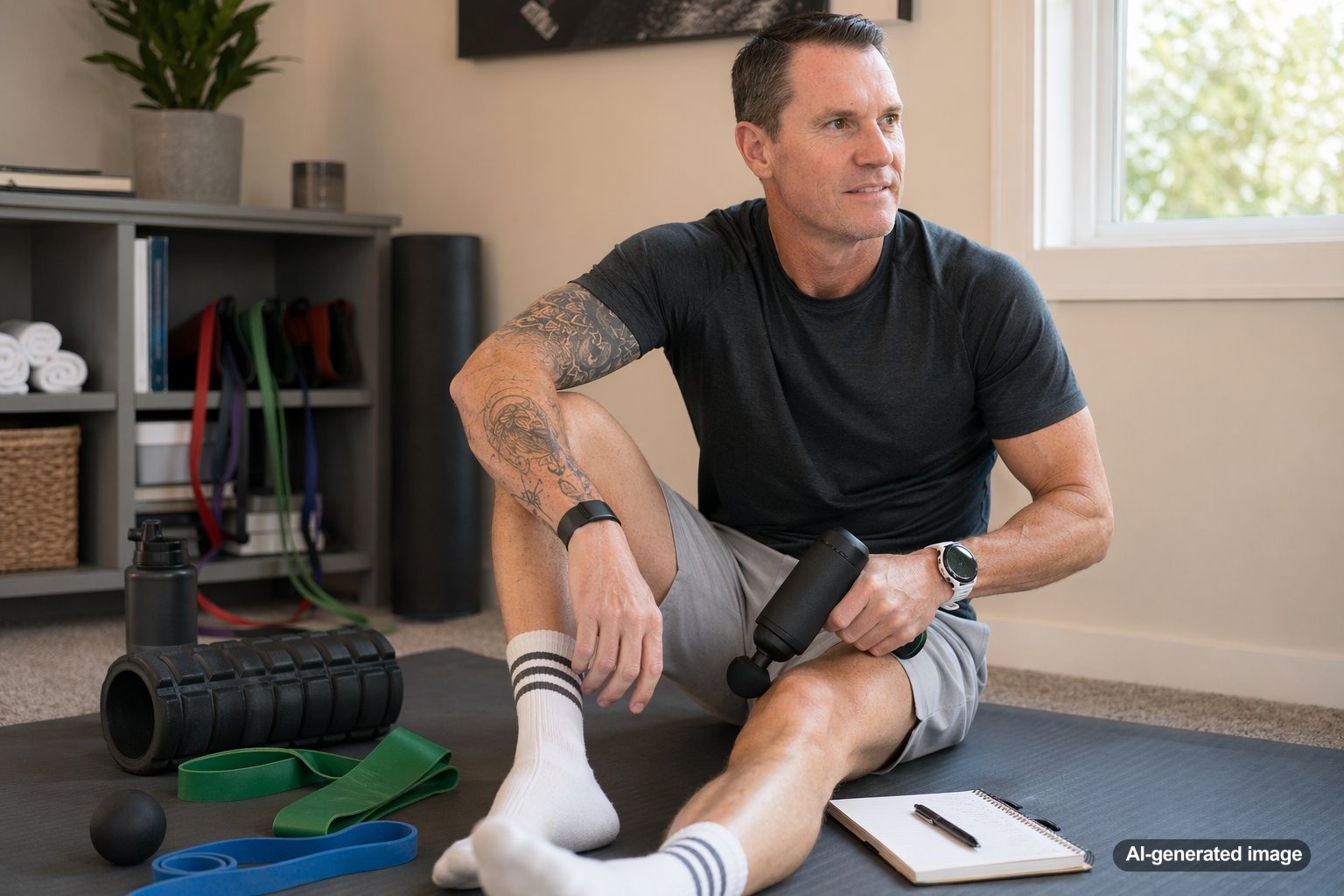
Start with three basics: a comfortable floor mat, a stable chair or bench, and storage that keeps tools visible. Visibility matters. When recovery tools are easy to see, they become part of the rhythm of the day instead of another forgotten purchase.
A smart budget setup might include a yoga mat or exercise mat, one basket for soft items, one small bin for bands and balls, and a place to sit while using compression, heat, or breathing routines. If you can keep the setup ready without rearranging the room every time, you have already solved one of the biggest barriers to consistency.
Build the first layer: mobility and soft-tissue tools
The first layer of a home recovery lab should be inexpensive, durable, and versatile. A foam roller can be useful for general mobility work. A lacrosse ball or massage ball can help target smaller areas. Resistance bands can support activation, stretching, warmups, and light strength work. A stretching strap can make range-of-motion work more controlled and accessible.
These tools are not glamorous, but they are often enough to create a strong foundation. They also teach you to pay attention. Where do you feel tight? What changes after a long workday? Which side feels different after training? What helps you move with more confidence the next morning?
For endurance-minded people, this kind of feedback matters. Recovery is not only what happens after the finish line. It is what makes the next start line possible.
Add comfort tools without overspending
Once the foundation is in place, consider simple comfort tools. Reusable ice packs, a heating pad, compression socks or sleeves, a supportive pillow, and a quiet timer can make the space more useful without turning it into a high-cost project.
Heat and cold should be used thoughtfully. They are not one-size-fits-all solutions, and personal health history matters. Some people may need to avoid certain temperature-based tools or compression products depending on circulation, sensation, injury, or medical guidance. If you are unsure, speak with a qualified healthcare professional before making them part of your routine.
The point is not to collect every option. The point is to create a recovery menu. On some days, you may need gentle stretching and breath work. On others, you may need legs elevated and ten quiet minutes. A useful recovery lab gives you choices without overwhelming you.
Use technology only where it serves the routine
Technology can help, but it can also become a distraction. Massage guns, red light devices, smart compression systems, vibration platforms, and recovery wearables can all get attention, but they are not the starting point for most budget builds. Before buying anything expensive, ask whether it will solve a real problem in your routine.
A helpful test is simple: have you consistently used the low-cost version first? If you do not stretch with a strap, roll with a foam roller, or take ten minutes to reset, a more expensive tool may not change the habit. It may only make the unused corner more expensive.
That said, a single higher-cost item can make sense if it addresses a specific need, fits your body, and will realistically be used several times a week. Budget does not always mean buying the cheapest thing. It means spending where the return is clear.
Create a simple recovery routine
A home recovery lab becomes valuable when it supports a repeatable rhythm. That rhythm can be short. Five to fifteen minutes is enough for many people to start building consistency.
One simple routine might look like this: two minutes of quiet breathing, three minutes of gentle mobility, five minutes of targeted stretching, and two minutes of legs-up rest or journaling. Another might focus on post-training habits: hydrate, change clothes, use a foam roller briefly, stretch the hips and calves, then set up for sleep. The best routine is the one that feels realistic on an ordinary Tuesday, not just on a perfectly organized weekend.
For people living with Parkinson’s or another health condition, movement routines should be personalized with appropriate clinical guidance. Recovery can support daily life, but it should not be framed as a substitute for care. Greg’s message of forward motion is grounded in resilience, not denial. Support, medical guidance, family, and community all matter.
What people often miss when building a recovery space
The overlooked part of recovery is environment. Light, sound, clutter, and timing all influence whether you use the space. A budget recovery lab can become more effective simply by making it calmer. Use soft lighting if possible. Keep the floor clear. Place your phone away from your mat unless you are using it for a timer or guided routine. Put tools back in the same place every time.
Another overlooked detail is transition. Recovery often works best when it attaches to something you already do. After a run. Before bed. After a shower. After work. Before a long travel day. The habit becomes stronger when it has a predictable anchor.
Finally, do not ignore emotional recovery. A good recovery lab is not just for sore muscles. It can become a place to breathe, reflect, regroup, and remember that progress is often built in small, quiet decisions. That is a deeply practical form of resilience.
A realistic budget starter setup
You can build a strong starter setup without buying everything at once. Begin with the basics, then upgrade only after you know what you actually use.
- Floor mat: The base of the space for stretching, mobility, breathing, and light strength work.
- Foam roller: A versatile tool for general mobility and post-training routines.
- Massage ball: Useful for smaller areas where a roller feels too broad.
- Resistance bands: Helpful for activation, warmups, shoulder work, hip work, and light strengthening.
- Stretching strap: Simple, inexpensive, and useful for controlled flexibility work.
- Reusable ice pack and heating pad: Practical comfort tools when appropriate for your body and situation.
- Notebook or habit tracker: A low-tech way to notice patterns in sleep, soreness, energy, and training response.
Once those pieces are in place, live with them for a month. Notice what gets used. Notice what stays untouched. Then make the next decision from experience instead of impulse.
FAQ
Do I need expensive recovery equipment to get results?
No. Many people can build a useful recovery routine with basic tools, consistent habits, and a quiet space. Expensive equipment may be helpful in some situations, but it should come after you understand your actual needs.
How much space do I need for a home recovery lab?
Enough space for a mat is a good starting point. A small corner can work if it is clean, accessible, and easy to reset.
How often should I use a recovery space?
That depends on your body, training, schedule, and goals. A short daily routine may be useful for some people, while others may use the space after workouts, travel, or demanding days. Consistency matters more than perfection.
Can a recovery lab help if I am not an athlete?
Yes. Recovery is not only for racers or competitors. It can support mobility, stress management, daily movement, and a more intentional relationship with your body.
Should I talk to a professional before starting?
If you have a medical condition, injury, pain, circulation concerns, neurological symptoms, or uncertainty about what is safe, speak with a qualified healthcare professional. A recovery space should support your life, not replace personalized guidance.
Interested in bringing Greg’s message to your event or organization?
Learn more about Greg’s speaking work or get in touch to start the conversation.
Contact Greg or learn more about the Forward Motion Fund.
This article is for educational purposes only and is not medical advice. For diagnosis, treatment, or personalized medical guidance, please speak with a qualified healthcare professional.