Why Push-Ups Get Harder With Age And How To Improve Them
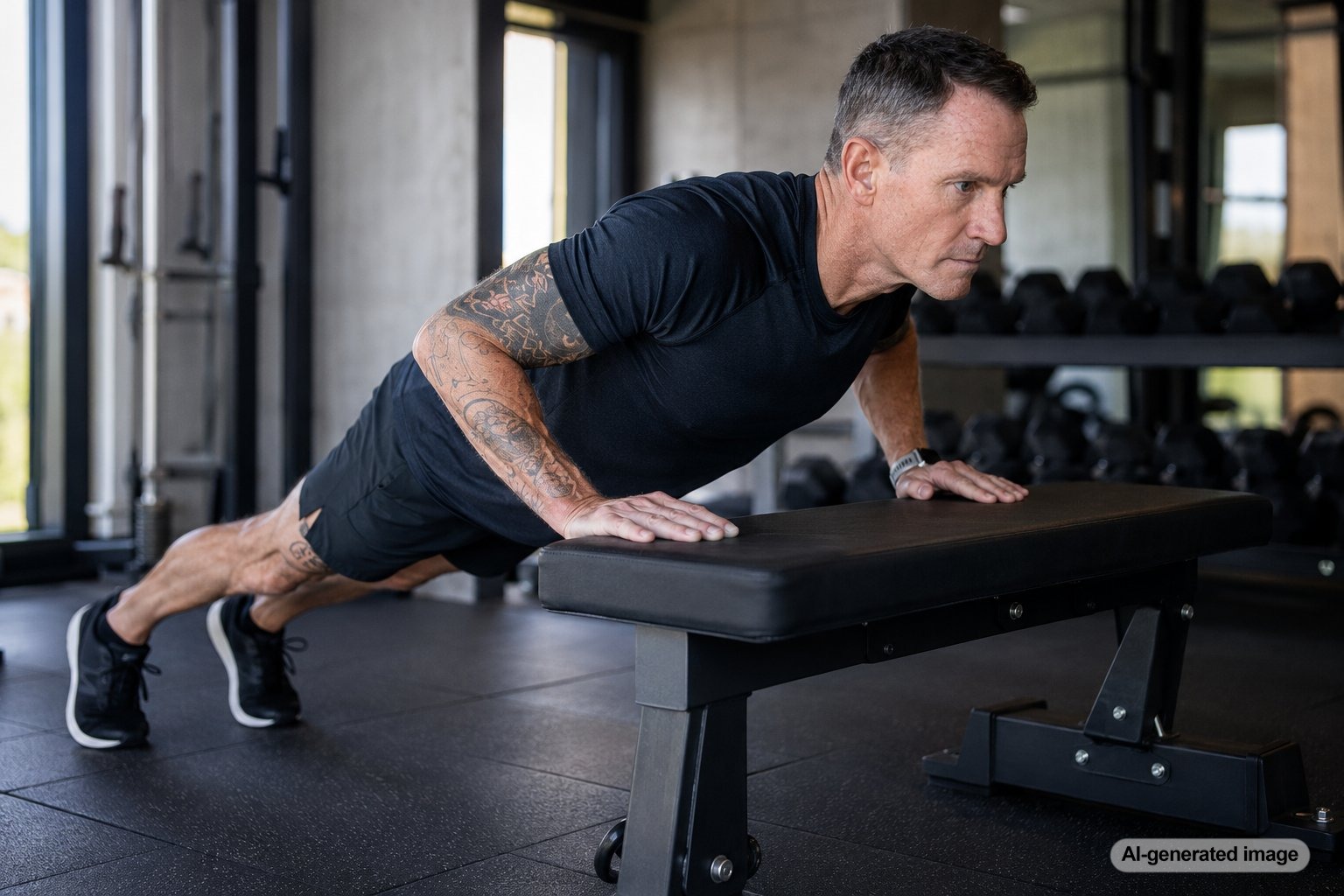
Push-ups often get harder with age because the movement demands more than chest strength. A solid repetition requires shoulder mobility, core control, wrist tolerance, upper-body strength, and the ability to move your body as one connected unit. When any of those qualities decline through inactivity, old injuries, changing routines, or reduced training consistency, the push-up exposes the gap quickly.
That does not mean push-ups are only for younger athletes. With the right progression, many adults can rebuild the strength and control needed to perform them well. The goal is not to force repetitions at any cost. It is to train the movement intelligently, protect the joints, and create steady progress that supports an active life.
That patient, repeatable approach reflects the same mindset Greg brings to endurance sports, leadership, family, and the broader story shared on his About page: meaningful progress usually comes from doing the next useful thing well.
Quick answer
- Push-ups may feel harder with age because of reduced upper-body strength, less shoulder or wrist mobility, weaker core control, and lower training consistency.
- Body composition changes can increase the amount of weight you must move relative to your strength.
- Elevated push-ups are often a better starting point than struggling through poor repetitions from the floor.
- Improvement comes from practicing good form, strengthening supporting muscles, and progressing gradually.
- Pain is not a requirement for progress. Persistent or sharp discomfort should be evaluated by a qualified professional.
Why push-ups tend to feel harder over time
A push-up is sometimes described as a simple bodyweight exercise, but simple does not mean easy. Your hands stay fixed while your shoulders, elbows, rib cage, spine, pelvis, and legs must coordinate through every repetition.
Several changes can make that coordination more demanding as the years pass.
Relative strength may decline
A push-up asks you to move a meaningful portion of your body weight. If pressing strength decreases while body weight stays the same or increases, the exercise becomes harder even if your technique has not changed dramatically.
This is one reason someone may still handle familiar dumbbells but struggle with floor push-ups. The bodyweight movement may represent a larger challenge relative to current strength.
Shoulder mobility and control can change
Daily life often places the shoulders in a limited range. Hours at a desk, driving, or using a phone can contribute to stiffness through the upper back and shoulders. Previous injuries may also change how confidently someone loads the joint.
During a push-up, the shoulder blades should move naturally around the rib cage. When that motion is restricted or poorly controlled, the exercise may feel unstable, awkward, or uncomfortable.
Core endurance may be the limiting factor
A strong push-up resembles a moving plank. The ribs and pelvis should remain controlled while the entire body lowers and rises together. If the midsection loses tension, the hips may sag, the lower back may arch, or the head may reach the floor before the chest.
Someone may have enough arm strength for another repetition but lack the trunk endurance to keep the movement organized.
Wrists and elbows may tolerate less sudden loading
Push-ups place the wrists in an extended position while the elbows repeatedly bend under load. Long gaps in training, repetitive work, or old injuries may make those positions less comfortable than they once were.
This does not always mean the movement must be abandoned. It may mean the angle, range of motion, hand position, or total volume needs to be adjusted.
Practice becomes less consistent
Many adults stop doing push-ups regularly long before they notice a decline. Work, family responsibilities, travel, stress, and changing priorities can quietly remove the movement from a routine.
Then a person tests push-ups months or years later and assumes age is the entire explanation. In reality, lack of recent practice may be a major factor. Specific movements usually improve when they are trained consistently and at an appropriate level.
How to improve push-ups without forcing them
The most effective starting point is the version that allows controlled repetitions without pain or major form breakdown. For many people, that means beginning above the floor.
Start with an elevated surface
Place your hands on a stable wall, countertop, sturdy bench, or secured bar. A higher surface reduces the percentage of body weight you must move. As strength improves, gradually use lower surfaces.
This approach preserves the basic push-up pattern better than repeatedly attempting floor repetitions that collapse halfway down. It also makes progression easy to measure: the same number of quality repetitions at a lower height represents real improvement.
Build a strong starting position
Set your hands slightly wider than shoulder width unless another position feels more natural. Keep the fingers spread, create gentle pressure through the whole hand, and position the shoulders comfortably over or slightly behind the wrists.
Brace the midsection as though preparing for a light impact. Keep the glutes and legs active. Your body should form a controlled line rather than several disconnected segments.
Control the lowering phase
Many people drop quickly and fight to press back up. Instead, lower under control for two or three seconds. Allow the elbows to travel at a comfortable angle rather than flaring directly sideways.
A slower lowering phase builds awareness and exposes the exact point where control is lost. Stop before the shoulders roll forward, the hips sag, or discomfort appears.
Use an appropriate range of motion
Full range can be a useful long-term goal, but it should not come at the expense of joint comfort or body position. Begin with the deepest controlled range you can repeat consistently.
Over time, increase depth before adding large numbers of repetitions. Five well-controlled push-ups through an honest range often provide more useful training than fifteen rushed repetitions.
Strengthen the supporting pieces
Push-ups can improve faster when the surrounding qualities are trained directly. Useful options may include:
- Planks or elevated plank holds for trunk control
- Dumbbell or machine presses for pressing strength
- Rows for upper-back strength and shoulder balance
- Wall slides or controlled shoulder-blade movements for mobility and coordination
- Farmer carries for total-body tension and grip strength
- Gentle wrist preparation before loading
The purpose is not to create a complicated program. It is to address the weak link that prevents the push-up from feeling stable and repeatable.
A practical push-up progression
Choose a stable surface that allows roughly six to twelve smooth repetitions while leaving a few good repetitions in reserve. Complete two or three sets, two or three times per week, with at least a day between challenging sessions.
Stay at the same height until you can complete every set with consistent form. Then lower the surface slightly or add one or two repetitions per set. Change only one variable at a time so you can tell whether the progression is working.
A simple sequence might look like this:
- Wall push-ups
- High countertop push-ups
- Bench or secured-bar push-ups
- Low elevated push-ups
- Floor push-ups with a reduced range
- Full floor push-ups
Knee push-ups can also be useful, but they are not automatically the best next step for everyone. Elevated push-ups often make it easier to maintain a straight-body position and adjust difficulty in smaller increments.
Common mistakes that slow progress
- Testing instead of training: Attempting a maximum number of floor push-ups every session creates fatigue without providing enough quality practice.
- Progressing too quickly: Moving to a lower surface before form is stable often leads to shorter range and compensations.
- Ignoring the upper back: Pressing strength matters, but rows and shoulder-blade control help create a more stable base.
- Holding the breath: Controlled breathing can help maintain rhythm and reduce unnecessary tension.
- Training through joint pain: Sharp, persistent, or worsening discomfort is a reason to stop and seek qualified guidance.
What progress should actually look like
Progress is not limited to completing more floor repetitions. It may mean using a lower surface, reaching a deeper range, moving more slowly, keeping the hips level, or finishing a set without wrist discomfort.
Those improvements matter because the larger goal is usable strength. Push-ups can support the ability to get up from the floor, brace during physical tasks, carry equipment, play with children, and remain capable in everyday life.
For athletes, leaders, and busy adults, progress also requires restraint. There is a time to push and a time to adjust the plan. Sustainable effort, not constant proof, is what keeps forward motion possible. Greg explores that same relationship between resilience, preparation, and performance through his speaking work.
Frequently asked questions
How often should I practice push-ups?
Two or three focused sessions per week may be enough for many people. The right frequency depends on your current ability, total training program, recovery, and joint comfort. Avoid repeatedly training to complete exhaustion.
Are wall push-ups effective?
Wall push-ups can be an effective entry point for learning the movement, rebuilding confidence, or returning after a long break. They become more challenging when the feet move farther from the wall or the hands move to a lower surface.
Should my chest touch the floor?
Touching the floor is not required if you cannot maintain control or if the position causes discomfort. Use the deepest pain-free range you can perform with stable form, then expand that range gradually.
Why do my hips sag during push-ups?
Sagging hips may reflect fatigue, limited core endurance, insufficient glute tension, or a push-up variation that is currently too difficult. Raising the hands and practicing plank holds may help improve control.
Can I improve push-ups after 50?
Age alone does not prevent improvement. Progress may require more attention to preparation, recovery, mobility, and gradual loading, but consistent practice at the right difficulty can build meaningful strength at many stages of adulthood.
Interested in bringing Greg’s message to your event or organization?
Learn more about Greg’s speaking work or get in touch to start the conversation.
Contact Greg or learn more about the Forward Motion Fund.
This article is for educational purposes only and is not medical advice. For diagnosis, treatment, or personalized medical guidance, please speak with a qualified healthcare professional.