Why Men Over 40 Lose Muscle Faster Than They Expect
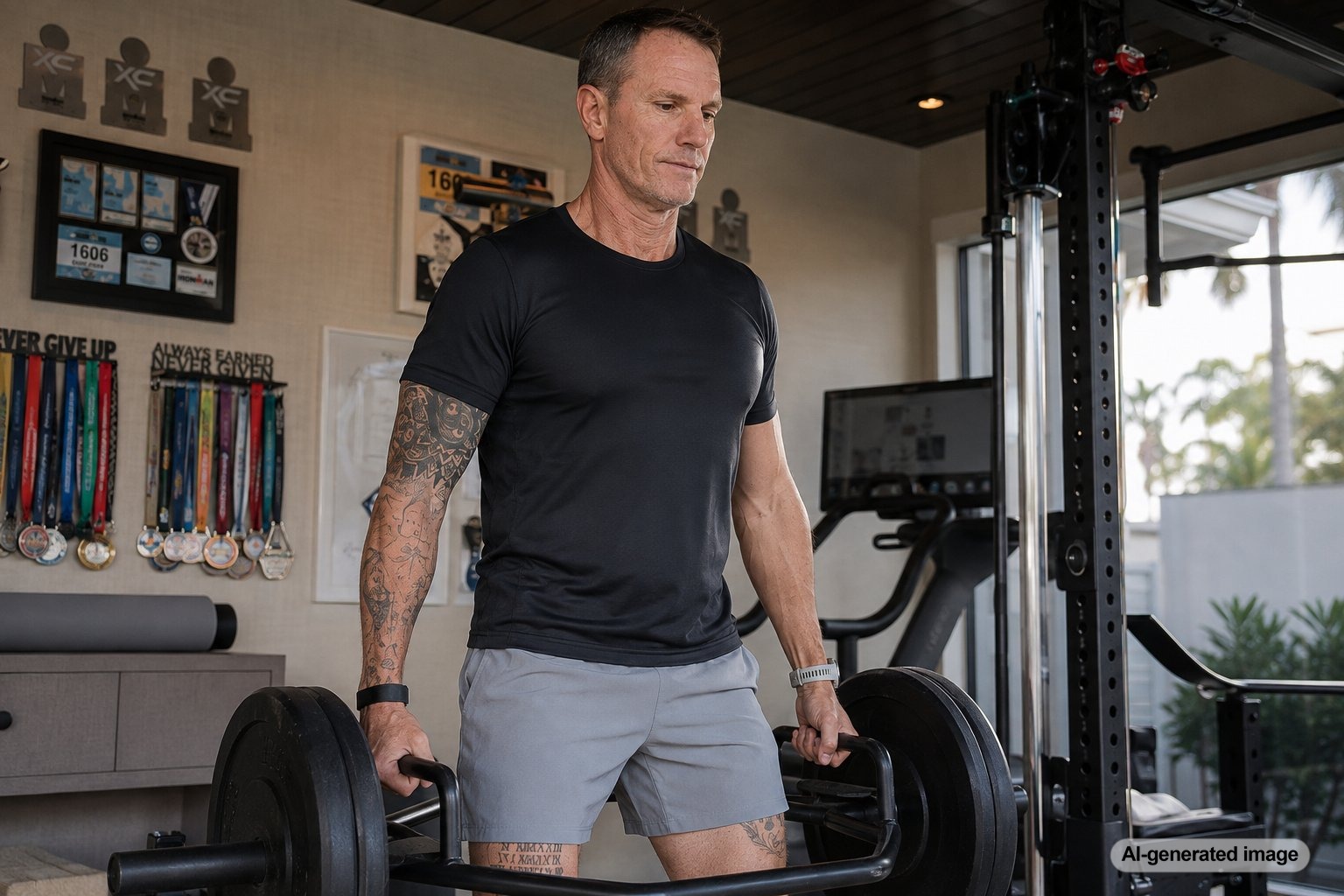
For a lot of men, muscle loss after 40 does not announce itself dramatically. The same shirts still fit. The scale may barely move. Workouts may still look respectable on paper. Yet a heavy suitcase feels a little heavier, recovery takes a little longer, and strength that once seemed automatic starts requiring more deliberate work.
That change is not simply a matter of getting older and accepting decline. Aging can affect muscle mass, strength, recovery, and the body’s response to training, but inactivity and periods of disuse can accelerate those changes. The practical lesson is less about chasing youth and more about protecting capacity. Greg Schaefer’s life as an endurance athlete, entrepreneur, dad, and advocate reflects a broader principle explored throughout his story: what you consistently train and protect matters.
Quick answer
- Age-related changes can make it harder to build and preserve skeletal muscle compared with earlier adulthood.
- Muscle strength and muscle size are related, but they are not identical. A person can notice declining performance even before a dramatic visual change.
- Periods of inactivity, illness, injury, or reduced training can accelerate muscle loss, particularly as people get older.
- Progressive resistance training remains one of the strongest tools available for maintaining strength and physical function.
- Nutrition, sleep, recovery, health conditions, and training consistency all influence the bigger picture.
Why muscle loss after 40 can feel surprisingly fast
The phrase “muscle loss” can create the wrong mental picture. Most men do not wake up one morning looking noticeably smaller. The process can be subtle enough that it is first experienced as a performance problem rather than an appearance problem.
You may find that the weight you once lifted comfortably now requires more effort. A hard workout may take longer to recover from. Running hills, carrying equipment, getting up from the floor, or completing repeated physical tasks can feel different even if your body weight has barely changed.
Research on aging describes gradual changes in skeletal muscle mass, strength, and function. The broader age-related syndrome involving losses in muscle strength, mass, and physical performance is commonly discussed under the term sarcopenia. Importantly, reaching 40 does not mean someone automatically has sarcopenia, nor does it mean rapid decline is inevitable. Age is one part of a much larger equation.
Your muscles may respond differently to the same stimulus
One reason maintaining muscle becomes more demanding with age is that older skeletal muscle can show a less robust anabolic response to exercise and nutrition than younger muscle. In practical terms, the training routine that once produced noticeable gains with relatively little planning may eventually require better consistency, progression, recovery, and nutritional support.
This does not make productive training impossible. Resistance exercise remains highly valuable as people age. It simply means that doing “about the same amount” indefinitely may not preserve the same result forever.
That distinction matters for former athletes in particular. A strong athletic history is valuable, but past fitness is not stored permanently. Someone who trained seriously at 25 and 35 still needs an appropriate stimulus at 45, 55, and beyond if maintaining strength and function is the goal.
Strength can change before the mirror tells the story
Men often use appearance as their primary measure of muscle. That can hide important changes. Strength, power, coordination, muscle quality, and physical function are not perfectly represented by arm circumference or body weight.
Consider a man who weighs roughly the same for several years. He might assume his body composition and physical capacity are unchanged. Yet if his resistance training has disappeared, his daily movement has fallen, and his demanding physical tasks have become less frequent, the scale may be masking meaningful changes.
This is why useful markers can include what your body can actually do: lifting a challenging load with good technique, climbing stairs comfortably, carrying groceries, maintaining balance, getting off the floor, or preserving strength across repeated efforts.
Disuse becomes a bigger problem than many men realize
One overlooked factor in muscle loss after 40 is not aging alone. It is the combination of aging and disuse.
A demanding job becomes more sedentary. A minor injury interrupts training. Travel breaks a routine. Family responsibilities crowd out gym time. An illness creates several weeks of inactivity. None of these situations seems extraordinary, but repeated periods of reduced muscular loading can add up.
Research examining muscle disuse in aging suggests that inactivity, immobilization, illness, and similar periods of unloading can accelerate muscle atrophy, while recovery from these periods may become more difficult with age. That makes consistency increasingly valuable. The goal is not perfection. It is avoiding the repeated cycle of becoming inactive, rebuilding, stopping again, and expecting the body to respond exactly as it did decades earlier.
Endurance fitness does not replace strength training
This distinction deserves special attention for runners, cyclists, triathletes, and other endurance-minded men. Cardiovascular fitness and muscular strength overlap in useful ways, but they are not interchangeable.
You can have an excellent aerobic engine while still losing strength or muscle in areas that are not receiving enough resistance. Long rides and runs can build tremendous endurance, discipline, and sport-specific capacity, but they do not necessarily provide the progressive loading needed to maximize or preserve muscle throughout the entire body.
For an endurance athlete, strength work is therefore not simply bodybuilding added to the side of a “real” program. Appropriate resistance training can be part of protecting the body that makes endurance possible.
Recovery deserves more attention than it did at 25
A common mistake is responding to age-related changes by simply training harder. More volume is not automatically better. Effective training depends on the balance between challenge and recovery.
Sleep, adequate food intake, protein intake, stress, training frequency, medical conditions, medications, injuries, and overall activity can all influence a person’s ability to recover and adapt. Individual needs vary substantially, which is one reason generic prescriptions are rarely ideal.
The productive question is not, “How do I train exactly like I did when I was younger?” It is, “What level of training can I perform consistently, recover from, and progressively build on now?”
What men over 40 can focus on
There is no single routine appropriate for every person, but several principles are useful when the goal is preserving physical capacity.
- Keep resistance training in the picture. Research supports resistance exercise as an important strategy for improving or preserving muscular strength and physical function in older adults.
- Use progression rather than random effort. Muscles need meaningful resistance. That does not mean every session must be maximal, but training should have enough structure to create an appropriate challenge over time.
- Do not ignore inactivity. A month away from structured training is different from a few planned recovery days. When life interrupts a routine, returning gradually can matter more than waiting for the perfect restart.
- Pay attention to function. Track useful performance markers, not only body weight or appearance.
- Treat recovery as part of training. Sleep, nutrition, stress management, and appropriate rest help support the work performed in the gym.
- Adjust when your health changes. New weakness, unexplained loss of muscle, significant fatigue, pain, balance problems, or other concerning changes deserve discussion with a qualified healthcare professional rather than being dismissed as “just aging.”
The overlooked advantage of starting before there is a problem
Strength is easier to appreciate after some of it disappears. A more useful approach is to treat muscle as long-term physical infrastructure.
The goal is not necessarily bigger arms or a personal record in the gym. Muscle supports independence, athletic performance, balance, force production, resilience, and the ability to keep doing meaningful things. For one person that may mean racing. For another it may mean hiking with family, handling luggage without help, playing with children, or staying capable through a demanding career.
That mindset also fits a larger principle behind Greg’s approach to adversity: forward motion is often built through repeated, manageable actions rather than one heroic effort. Organizations looking to explore that connection between resilience, leadership, discipline, and performance can learn more about Greg’s speaking work.
Frequently asked questions
Does every man start losing muscle at exactly age 40?
No. Age-related changes occur gradually and vary considerably among individuals. Training history, activity level, nutrition, health, genetics, sleep, injuries, and other factors can influence muscle mass and strength. Forty is better viewed as a useful point to become more deliberate about maintaining physical capacity than as a biological deadline.
Can you still build muscle after 40?
Yes, adults can respond positively to resistance training later in life. The magnitude and speed of adaptation vary, and older muscle may not respond exactly like younger muscle, but aging does not eliminate the ability to improve strength and muscular function.
Is cardio enough to prevent muscle loss?
Cardiovascular exercise provides important benefits, but it does not fully replace resistance training when the specific goal is maintaining muscular strength and mass. A balanced program may include both depending on the person’s goals and health.
Should men over 40 take protein supplements?
Protein is important for muscle maintenance, but supplementation is not automatically necessary for everyone, and research on additional supplementation in older populations has produced results that vary by population and context. Total diet, training, health, and individual nutritional needs matter. A physician or registered dietitian can provide personalized guidance when needed.
When should muscle loss be discussed with a doctor?
Unexplained or rapid loss of muscle, new weakness, persistent fatigue, problems with balance or walking, significant unintentional weight loss, or a major change in physical function should be evaluated by a qualified healthcare professional rather than assumed to be normal aging.
Interested in bringing Greg’s message to your event or organization?
Learn more about Greg’s speaking work or get in touch to start the conversation.
Contact Greg or learn more about the Forward Motion Fund.
This article is for educational purposes only and is not medical advice. For diagnosis, treatment, or personalized medical guidance, please speak with a qualified healthcare professional.