

The Best Low-Impact Cardio For Men With Achy Joints
Achy knees, hips, ankles, or a stiff lower back can make cardio feel like a choice between doing too little and paying for it later. It does not have to be. The best low-impact cardio for men with achy joints is usually the option that raises the heart rate without creating sharp pain, heavy pounding, or a recovery bill that disrupts the rest of the week.
For many men, that means building a rotation around cycling, swimming, water exercise, elliptical training, and purposeful walking. The right choice depends on which joints bother you, how much weight-bearing you tolerate, your balance, your current conditioning, and what equipment you can use consistently. Greg Schaefer’s broader story of endurance, leadership, and forward motion reflects a useful principle here: sustainable progress comes from adapting the path, not abandoning the goal.
Quick answer
- Best all-around option: A stationary bike offers adjustable resistance, predictable movement, and no landing impact.
- Best when weight-bearing hurts: Swimming or water exercise reduces the load carried by the hips, knees, and feet.
- Best gym option: An elliptical provides a smooth, continuous stride while keeping the feet supported.
- Best no-equipment option: Walking can work well when pace, surface, footwear, and duration are matched to your tolerance.
- Best long-term plan: Rotate two or three modes so the same tissues are not stressed the same way every session.
What low-impact cardio actually means
Low impact does not mean low effort. It describes how much collision, landing force, or abrupt loading reaches the body. You can work hard on a bike, in a pool, or on an elliptical while avoiding the repeated foot strikes associated with running and jumping.
That distinction matters because cardiovascular intensity and joint impact are separate variables. A workout can be challenging for the heart and lungs while remaining relatively controlled at the knees, hips, ankles, and spine. The goal is not to eliminate all stress. Healthy training applies a manageable dose of stress, then allows the body to recover and adapt.
There is also no single machine or activity that is automatically joint-friendly for every man. A bike can irritate a knee if the seat is too low. Walking can aggravate a painful foot if the surface is hard or the stride is forced. Swimming can bother a shoulder when technique or volume exceeds tolerance. Equipment setup and movement quality matter as much as the activity label.
1. Stationary cycling: the strongest all-around choice
A stationary bike is often the most practical starting point because it removes landing impact and makes intensity easy to control. You can change resistance in small steps, stop immediately, and measure time or effort without worrying about traffic, weather, or uneven ground.
An upright bike tends to feel more athletic and may transfer better to outdoor cycling. A recumbent bike provides back support and a wider seat, which some men find more comfortable when balance, back stiffness, or confidence is a concern.
Setup details that protect comfort
- At the bottom of the pedal stroke, keep a slight bend in the knee rather than locking it or remaining deeply bent.
- Start with light resistance and a smooth cadence instead of grinding a heavy gear.
- Keep the hips stable on the seat rather than rocking side to side.
- Use short sessions first, then add minutes before adding hard resistance.
If knee discomfort increases as the knee stays deeply flexed, raising the seat slightly may help, but large setup changes should not be guessed at when pain is persistent. A physical therapist, qualified clinician, or experienced bike fitter can assess position more precisely.
2. Swimming and water exercise: the least weight-bearing option
Water supports much of the body’s weight, making pool-based cardio especially useful when standing exercise irritates the hips, knees, feet, or lower back. Swimming laps is one route, but it is not the only one. Water walking, deep-water running with a flotation belt, and structured aqua fitness can all raise the heart rate.
The best pool option is the one that matches your skill and joints. Freestyle may feel smooth for one person, while another prefers backstroke or water walking. Men with shoulder trouble may tolerate lower-body water exercise better than repeated overhead strokes.
Pool workouts also make interval training simple. Alternate one or two minutes of purposeful movement with an easier minute. The water keeps impact low, but effort can still become substantial.
3. Elliptical training: smooth and weight-bearing
The elliptical sits between cycling and walking. Your feet remain supported while the legs move through a gliding pattern, so there is no repeated landing. At the same time, you remain upright and weight-bearing, which some men prefer for a more familiar movement pattern.
Use a short, comfortable stride and modest resistance at first. Holding the rails lightly can help with balance, but leaning heavily on them may change posture and reduce the work performed by the legs. If the machine’s fixed path feels unnatural at the hips or knees, do not force it. Different elliptical designs can feel dramatically different.
4. Walking: simple, accessible, and easy to misjudge
Walking is often called low impact, but the dose matters. A ten-minute walk on a level track is very different from an hour on concrete, steep hills, or uneven trails. Men returning after inactivity sometimes increase distance too quickly because walking feels familiar.
Build walking volume with the same discipline used for any other training:
- Choose a flat, predictable route.
- Wear supportive shoes that feel comfortable now, not shoes you hope will break in.
- Keep the stride natural rather than reaching far forward with each step.
- Increase either pace or duration gradually, not both at once.
- Consider multiple short walks instead of one long session.
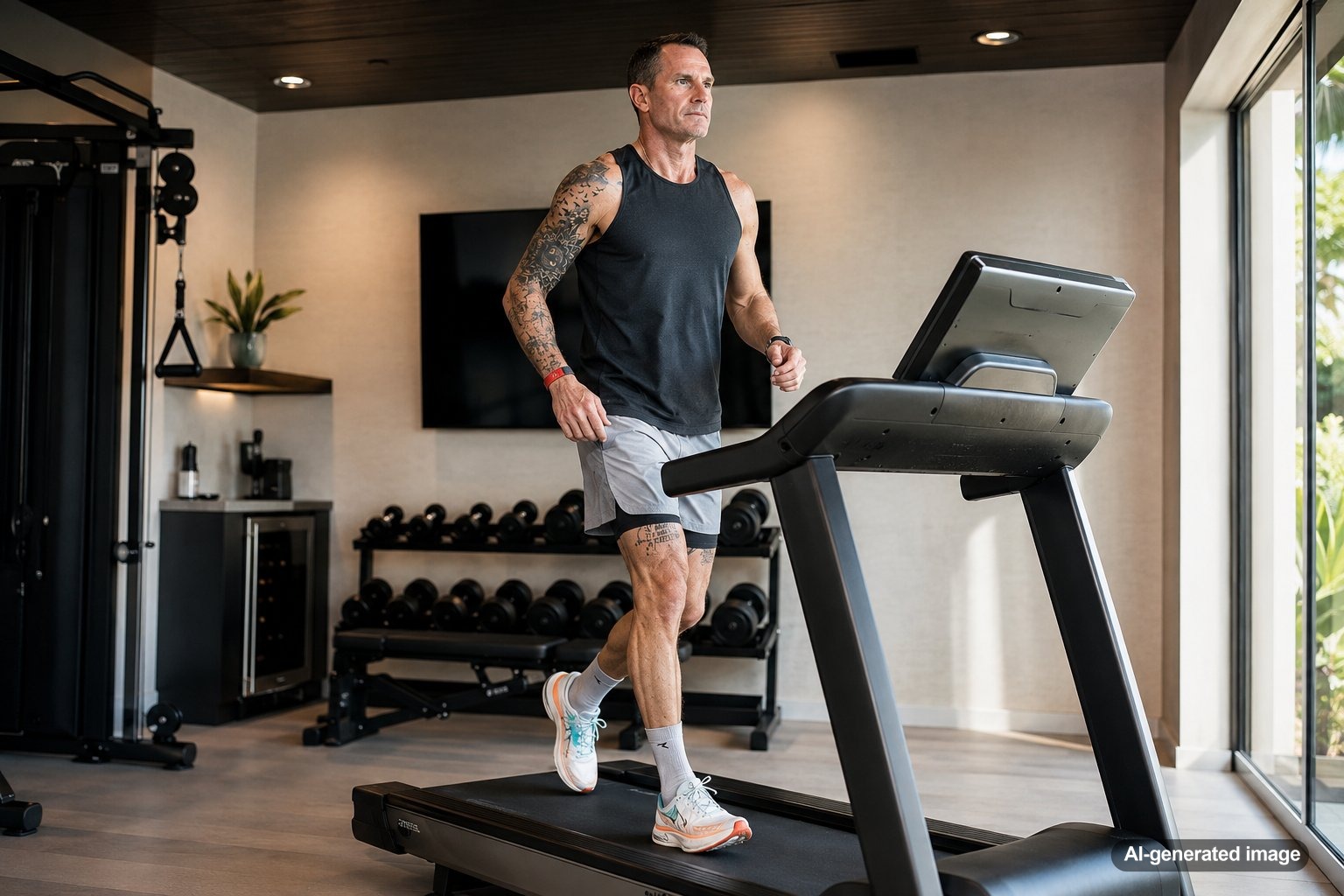
A treadmill can provide a consistent surface and easy speed control. Outdoor walking may be more enjoyable and easier to sustain. The better option is the one that leaves symptoms stable and keeps you coming back.
5. Rowing: useful, but more technique-dependent
A rowing machine is low impact because the feet stay planted and there is no landing force. It trains the legs, hips, trunk, and upper body while providing a demanding cardiovascular workout. However, it requires repeated knee and hip flexion plus coordinated trunk movement.
Men with certain back, hip, or deeply bent-knee symptoms may find rowing less comfortable than cycling or pool work. Begin with low resistance, controlled strokes, and a shorter range of motion. Avoid yanking with the arms or collapsing the lower back at the front of the stroke.
How to choose based on where you ache
Match the mode to the irritated area
- Knees: Try a well-fitted bike, pool exercise, or a comfortable elliptical. Watch deep knee bend and heavy resistance.
- Hips: Pool work and cycling may reduce pounding. A machine with an overly wide or fixed stride may feel irritating.
- Ankles or feet: Cycling, swimming, and deep-water exercise minimize repeated foot loading.
- Lower back: A recumbent bike or water walking may feel supportive, while rowing and aggressive cycling positions may require more care.
- Shoulders: Lower-body cardio such as cycling or walking may be preferable to swimming or rowing.
These are starting points, not diagnoses. Pain can come from many causes, and the same symptom location can respond differently from one person to another.
A joint-conscious cardio plan that still builds fitness
Consistency matters more than finding a perfect machine. Start with a level that feels almost too manageable, especially after a long layoff. A useful first structure is three cardio sessions per week with an easy day between them.
Sample two-week starting plan
- Monday: 15 to 20 minutes of easy cycling.
- Wednesday: 15 minutes of pool walking or elliptical training.
- Saturday: 20 minutes of easy walking on a level surface.
During the second week, add a few minutes to one or two sessions if symptoms remain manageable. Do not increase duration, resistance, speed, and frequency all at once. One change at a time makes it easier to identify what your joints tolerate.
Use the talk test to control effort. At a moderate pace, breathing is deeper but you can still speak in short sentences. Hard intervals can come later, once the movement itself feels predictable and recovery is reliable.
How to tell productive effort from a warning sign
Normal exercise sensations can include warmth, muscle fatigue, heavier breathing, and mild stiffness that settles. More concerning signs include sharp or escalating pain, a joint that gives way, marked swelling, new numbness, chest pain, dizziness, or symptoms that continue to worsen after the session.
A simple rule is to track how you feel during the workout, later that day, and the next morning. If every session creates a clear setback, the current dose or activity is not sustainable. Reduce time, resistance, range of motion, or frequency. Persistent or severe symptoms deserve evaluation by a qualified healthcare professional.
What men often get wrong
- Turning every workout into a test: Cardio does not need to prove toughness. Most sessions should be repeatable.
- Choosing resistance over rhythm: Heavy grinding on a bike or elliptical can increase joint demand without improving movement quality.
- Ignoring setup: Seat height, stride length, footwear, and posture can determine whether an activity feels smooth or irritating.
- Doing only cardio: Appropriate strength, mobility, and balance work can support better movement, but those elements should be matched to individual needs.
- Waiting for perfect comfort: Some men need to work within a manageable range rather than expecting every sensation to disappear before moving.
The role of strength and recovery
Low-impact cardio is only one part of a durable routine. Strong muscles can help manage force and support movement around the joints. Basic exercises such as a supported sit-to-stand, low step-up, glute bridge, calf raise, or resistance-band row may complement cardio when they can be performed comfortably and with good control.
Recovery also deserves structure. Alternate harder and easier days, sleep consistently, and avoid making up for missed sessions with sudden volume. Training through adversity is not the same as ignoring information from the body. The athlete mindset is most useful when it includes patience, adjustment, and the discipline to stay in the game.
Frequently asked questions
Is a bike or elliptical better for bad knees?
Neither is universally better. A bike removes landing impact and allows precise resistance control, but seat position affects knee bend. An elliptical keeps you upright with a smooth stride, but the machine’s path may not suit every hip or knee. Try brief, easy sessions and compare how you feel during and after each.
Can low-impact cardio still improve endurance?
Yes. Endurance responds to sustained cardiovascular work, not just running or jumping. Cycling, swimming, rowing, elliptical training, and brisk walking can all provide meaningful aerobic work when performed consistently at an appropriate intensity.
How often should I do low-impact cardio?
Frequency depends on your starting point, symptoms, recovery, and medical history. Many men begin with three short sessions per week and build gradually. Smaller, repeatable doses are often more useful than occasional long workouts that trigger a setback.
Should I exercise when my joints are sore?
Mild stiffness may improve with gentle movement, but sharp pain, significant swelling, instability, or worsening symptoms are reasons to stop and seek guidance. When uncertainty is high, a clinician or physical therapist can help determine an appropriate plan.
What is the best choice for weight loss?
The most effective option is usually the activity you can perform consistently enough to support a broader nutrition and activity plan. Joint comfort matters because an exercise that repeatedly sidelines you is difficult to sustain.
Bottom line
For most men with achy joints, stationary cycling is the best all-around place to start, while swimming or water exercise is especially useful when weight-bearing is difficult. Elliptical training, controlled walking, and rowing can also work when the movement fits your body and the dose is sensible.
The goal is not to find the toughest workout you can survive. It is to build a form of cardio you can repeat, progress, and trust. That is how fitness becomes part of forward motion rather than another cycle of stopping and restarting.
Interested in bringing Greg’s message to your event or organization?
Learn more about Greg’s speaking work or get in touch to start the conversation.
Contact Greg or learn more about the Forward Motion Fund.
This article is for educational purposes only and is not medical advice. For diagnosis, treatment, or personalized medical guidance, please speak with a qualified healthcare professional.


