
Red Light Therapy, Recovery, and Biohacking: What is Worth Asking Your Doctor About?
Red light therapy sits in a strange place right now. It is discussed in recovery rooms, wellness studios, endurance circles, and biohacking conversations, but the confidence people bring to it often runs ahead of the evidence. For athletes, leaders, and people navigating a health challenge, that makes the question less about hype and more about discernment.
Greg Schaefer’s world is built around forward motion: family, business leadership, endurance, advocacy, and learning how to keep moving when the path changes. That does not mean chasing every new tool. It means asking better questions, especially when a device or recovery trend claims to support energy, inflammation, sleep, pain, performance, or neurological health. If you are exploring this topic as part of your own resilience journey, Greg’s broader perspective on discipline and purpose is reflected throughout his story.
Quick answer: what is worth asking your doctor about?
- Ask whether red light therapy, also called photobiomodulation or low-level light therapy, is appropriate for your health history, medications, skin, eyes, and diagnosis.
- Ask what outcome you are actually trying to support: soreness, joint discomfort, wound healing, sleep, mood, exercise recovery, or something else.
- Ask whether there is evidence for your specific use case, not just for red light therapy in general.
- Ask about device quality, wavelength, dose, session time, safety precautions, and whether eye protection is needed.
- Ask how it fits with the fundamentals: exercise, sleep, nutrition, medication management, physical therapy, and medical care.
Why red light therapy gets so much attention
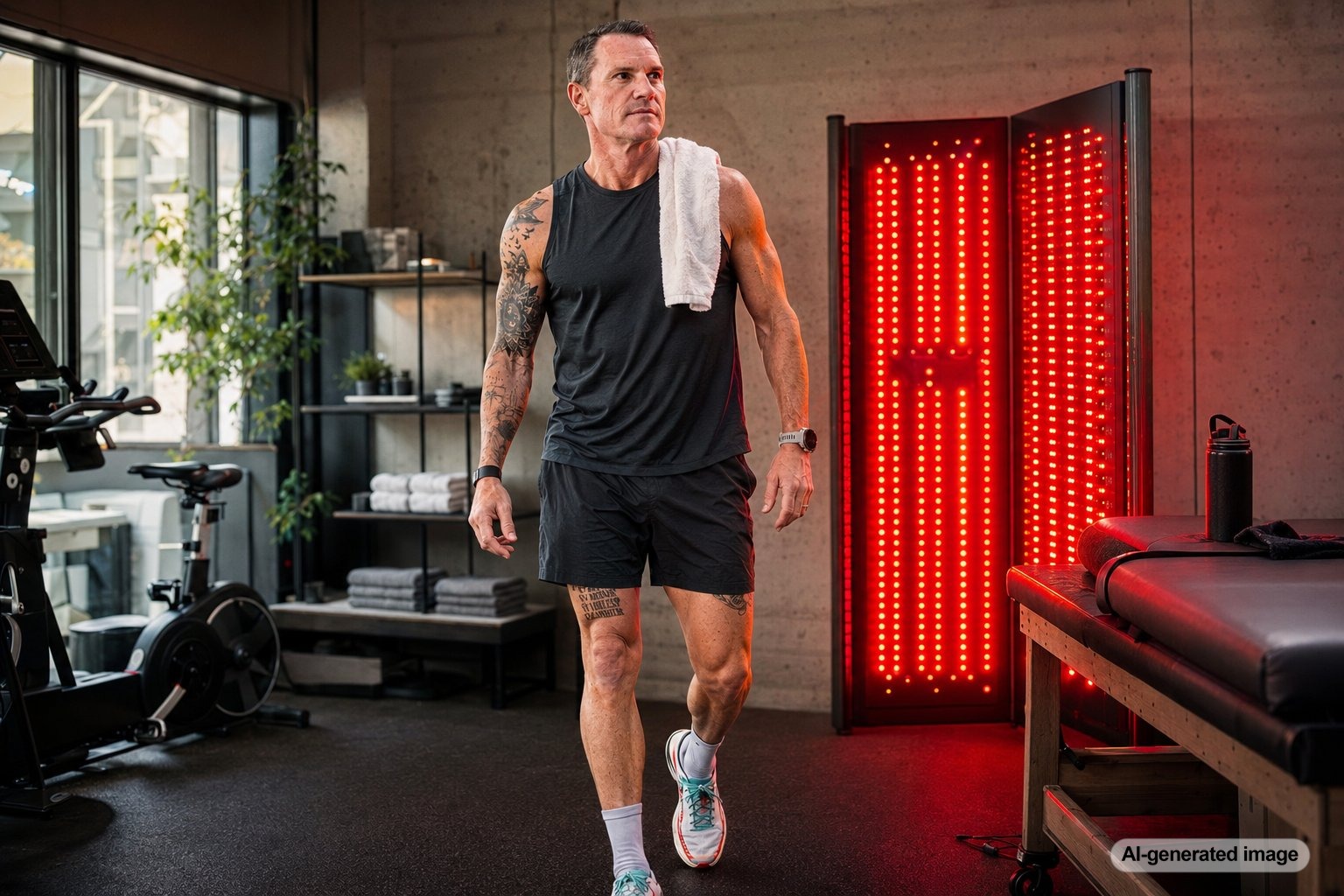
Red light therapy is often grouped under the broader term photobiomodulation. In plain language, it involves using red or near-infrared light from LEDs or lasers at low intensity, with the goal of influencing biological processes without creating the kind of heat associated with more aggressive light-based procedures.
That concept makes it attractive to people who care about recovery. The promise sounds simple: support the body’s repair systems, reduce soreness, calm inflammation, or improve performance. Some research explores those possibilities, including applications in pain, tissue repair, exercise recovery, and neurological conditions. The important distinction is that promising does not mean proven for every device, every person, or every condition.
For someone who trains hard, leads a business, travels for events, lives with Parkinson’s, or simply wants to feel better, the pull is understandable. The risk is treating a tool as a shortcut instead of one possible conversation point inside a larger plan.
The first question: what problem are you trying to solve?
Before asking whether red light therapy works, ask what you want it to do. That question will sharpen the conversation with your clinician and help you avoid vague wellness spending.
There is a difference between using a panel after a heavy training block, considering a device for joint discomfort, asking about skin or wound healing, or wondering whether light-based therapies have any role in neurological health. Those are not the same question. They involve different body systems, different evidence, different risks, and different expectations.
A useful doctor conversation might sound like this: “I am considering red light therapy for muscle soreness after endurance training. I have Parkinson’s, take these medications, and train this many hours per week. Is there any reason I should avoid it, and what evidence is relevant to my situation?” That is more productive than asking, “Is biohacking good?”
What athletes and active adults should keep in perspective
Recovery tools can be helpful, but they can also become a distraction from the basics that carry the most weight. Sleep, progressive training, strength work, mobility, hydration, nutrition, and enough rest between hard efforts are still the foundation. For people living with Parkinson’s, exercise and individualized movement planning are also a major part of long-term function and quality of life.
Red light therapy may be worth discussing if you are dealing with recurring soreness, trying to manage training load, or considering a recovery strategy that will not interfere with your current care. It should not replace a medical evaluation for pain, weakness, unusual fatigue, swelling, neurologic changes, or a training setback that keeps returning.
Greg’s message of “One More Step… Just One More” is not about ignoring signals from the body. It is about continuing with intention. Sometimes the strongest next step is a workout. Sometimes it is a rest day. Sometimes it is asking a better question before buying the next device.
What people often miss about biohacking
Biohacking sounds precise, but many consumer claims are not. The same phrase can refer to a medical-grade device, a wellness studio panel, a handheld unit, a helmet, a sauna add-on, or a product with little transparency. That matters because wavelength, power, dose, distance, treatment area, timing, and safety instructions can all change the risk-benefit conversation.
More is not automatically better. A longer session, stronger device, or more frequent use is not always smarter. Light-based therapies can have dose windows, and your clinician may want to factor in your skin type, eye health, cancer history, photosensitizing medications, implanted devices, neurological diagnosis, or other medical details.
Special considerations for Parkinson’s and neurological questions
Because Greg lives with Young-Onset Parkinson’s, it is important to be clear: red light therapy should not be presented as a Parkinson’s treatment plan or a substitute for medical care. Some early and emerging research has explored photobiomodulation in neurological contexts, including Parkinson’s-related studies, but that does not make consumer devices a proven answer for Parkinson’s symptoms or progression.
If you have Parkinson’s or another neurological condition, your doctor, neurologist, physical therapist, or movement disorder specialist can help you think through what is known, what is uncertain, and what could conflict with your current treatment plan. That conversation matters even more if a device is marketed with dramatic claims or if it encourages you to change medications, delay therapy, or ignore symptoms.
Complementary approaches can have a place in a person’s life, but they should be evaluated alongside medical care, not against it. That balanced approach is also consistent with Greg’s broader work through the Forward Motion Fund, where mission, research, support systems, and practical hope all belong in the same conversation.
Questions to bring to a clinician before trying it
- What outcome are we targeting? Recovery, pain, sleep, skin, wound healing, energy, stiffness, mood, or performance?
- Is there evidence for this exact use case? Ask about the difference between early research, strong evidence, and marketing claims.
- Are there reasons I should avoid it? Mention medications, eye conditions, skin history, cancer history, pregnancy, implanted devices, neurological conditions, and recent procedures.
- What device details matter? Ask about wavelength, power, distance, exposure time, frequency, and eye protection.
- How will we know whether it is helping? Decide what you will track: soreness, sleep quality, training readiness, pain levels, mobility, or another specific measure.
- What should not change? Make sure it does not replace prescribed treatment, physical therapy, exercise planning, or follow-up care.
Red flags that should make you pause
Be cautious with any product or provider that uses absolute claims, dismisses medical care, promises dramatic neurological outcomes, refuses to discuss risks, or treats every condition as if it has the same solution. A recovery tool should not pressure you into urgency. It should invite clarity.
Also be skeptical when a conversation skips over the actual details. “Red light” is not enough information. A responsible discussion should include the device type, intended use, dose, safety precautions, and what evidence applies to your situation.
FAQ
Is red light therapy the same as infrared sauna?
No. They can be discussed in similar wellness circles, but they are different. Red light therapy usually refers to targeted red or near-infrared light exposure through LEDs or lasers. Infrared saunas use heat exposure. The risks, goals, and questions for your doctor may be different.
Can red light therapy help athletic recovery?
Some research has explored photobiomodulation for exercise recovery, soreness, inflammation, and tissue repair. The practical answer depends on the device, dose, timing, training context, and your health history. It is worth asking about, but it should not replace smart programming, sleep, nutrition, and rest.
Should someone with Parkinson’s try red light therapy?
That is a personal medical question. People with Parkinson’s should speak with a qualified clinician before trying red light therapy, especially if the goal is neurological support. Early research interest does not equal a proven treatment plan, and Parkinson’s care should remain guided by qualified professionals.
What should I track if I try it with medical guidance?
Track one or two specific outcomes rather than a vague feeling of “better.” Examples include post-workout soreness, sleep quality, pain scores, mobility notes, training readiness, or symptom patterns. Share those notes with your clinician if they are helping you make care decisions.
Interested in bringing Greg’s message to your event or organization?
Learn more about Greg’s speaking work or get in touch to start the conversation.
Contact Greg or learn more about the Forward Motion Fund.
This article is for educational purposes only and is not medical advice. For diagnosis, treatment, or personalized medical guidance, please speak with a qualified healthcare professional.