How To Stay Calm In The Chaos Of Race Morning
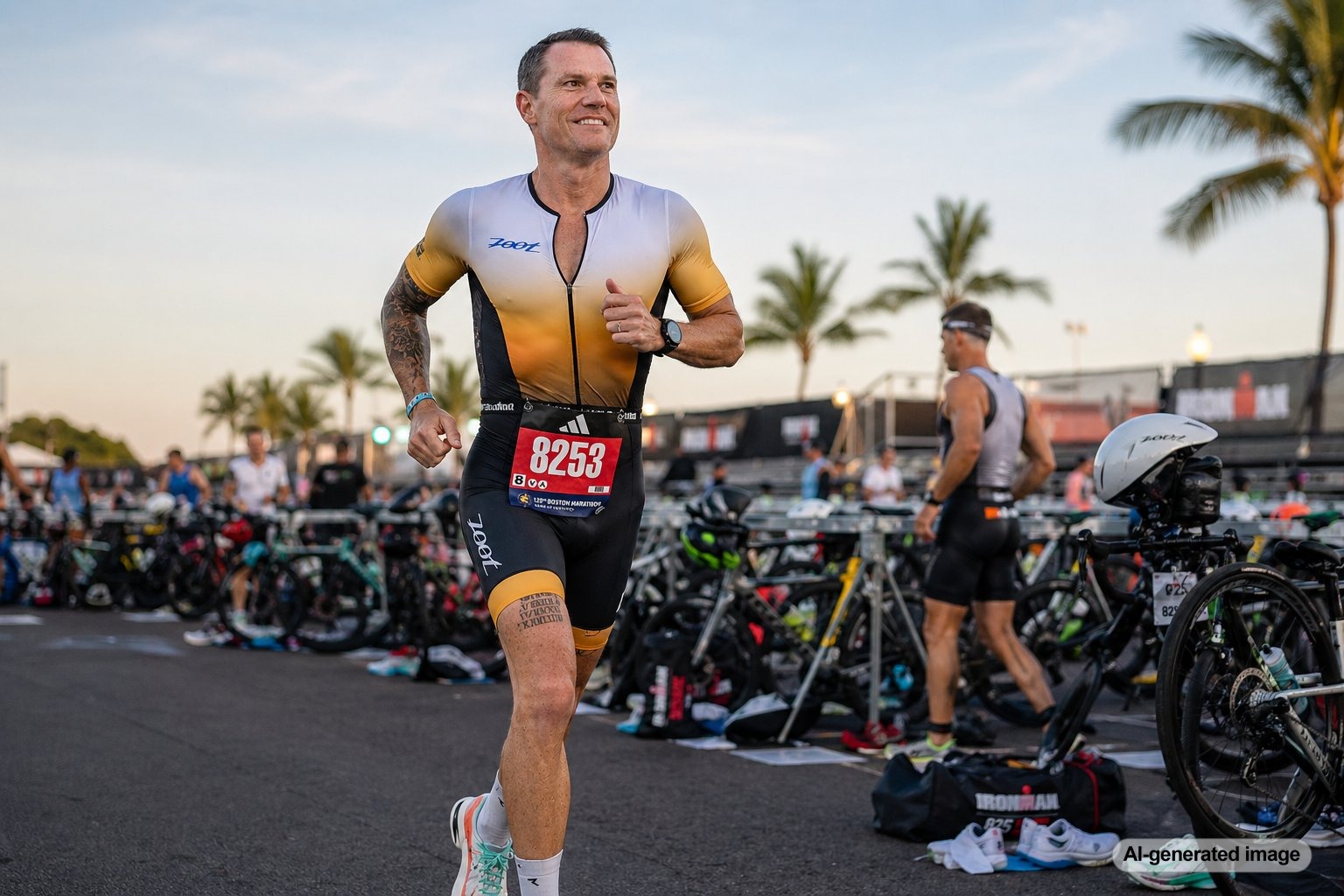
Race morning has a way of making even experienced athletes feel like beginners again. The alarm goes off early, the bags are packed, the body is awake before the mind is fully ready, and suddenly every small detail feels more important than it did the night before.
That chaos is not a sign that something is wrong. It is part of the start line. The goal is not to eliminate nerves completely. The goal is to create enough structure, perspective, and self-trust that you can move through the nerves without letting them take over. For Greg Schaefer, a 19-time Ironman, speaker, entrepreneur, dad, husband, and Parkinson’s advocate, race morning is a powerful reminder that forward motion often begins before conditions feel perfect. You do not need total calm to begin. You need one steady next step. Learn more about Greg’s story on the About Greg page.
Quick answer: how to stay calm on race morning
- Prepare the controllable details the day before so your morning has fewer decisions.
- Use a simple routine instead of trying to think your way into confidence.
- Separate useful nerves from panic. Energy can be helpful when you give it direction.
- Keep your attention on the next task, not the entire race.
- Return to a short phrase or cue that reminds you why you are there.
Accept that race morning will feel imperfect
One of the easiest ways to lose calm is to believe race morning should feel smooth, peaceful, and perfectly controlled. It rarely does. There may be long bathroom lines, misplaced gear, weather changes, a tight transition area, a rushed breakfast, or a strange ache that seems to appear out of nowhere.
Calm does not come from pretending those things are not happening. It comes from expecting some friction and deciding in advance that friction will not define your day. Athletes who handle race morning well are not always the most relaxed people in transition. They are often the ones who can notice the noise, acknowledge it, and stay connected to the next useful action.
That distinction matters. A nervous athlete can still be ready. A quiet athlete can still be unsure. Confidence is not always loud, and anxiety is not always a warning sign. Sometimes it is simply your body recognizing that the day matters.
Build a race morning routine before race morning
The best race morning routine begins long before the race. It starts with decisions made in advance: what you will eat, what time you will wake up, how you will lay out your gear, what you will check first, and what you will ignore until later.
A strong routine does not need to be complicated. In fact, the simpler it is, the more useful it becomes under pressure. Create a short sequence that you can follow almost automatically. Wake up. Eat. Hydrate. Dress. Check essentials. Leave. Set up transition. Breathe. Begin.
The value of routine is that it reduces the number of choices your brain has to make while adrenaline is high. Race morning is not the time to debate socks, nutrition, pacing strategy, or whether you packed the right bottle. Those choices belong to the calmer version of you who existed the day before.
Focus on the next task, not the whole race
Nothing makes race morning feel bigger than trying to mentally carry the entire event at once. If you are standing near the start thinking about every mile, every climb, every transition, every possible mistake, and every outcome, the race will feel impossibly heavy before it has even begun.
Bring the lens closer. Your job is not to complete the entire race in your head at 5:30 a.m. Your job is to do the next small thing well. Put the timing chip on. Check your goggles. Clip your helmet. Sip the bottle. Walk to the start. Take one breath. Find your place.
This is where endurance sports often mirror life. The biggest moments become more manageable when we stop trying to solve all of them at once. Forward motion is rarely dramatic in the moment. It is usually one decision, one breath, one step, one more step.
Give your nerves a job
Nerves are not always the enemy. They can sharpen attention, create energy, and remind you that you care. The problem begins when nerves are left without direction. Undirected energy becomes spiraling thought. Directed energy becomes readiness.
Instead of saying, “I should not be nervous,” try asking, “What can this energy help me do right now?” Maybe it helps you check your equipment carefully. Maybe it reminds you to start conservatively. Maybe it pushes you to be present with the people around you. Maybe it becomes gratitude for having reached another start line.
For athletes, leaders, and teams, pressure is not always something to escape. Often, it is something to organize. That is a message Greg brings into his speaking work as well: resilience is not about living without chaos. It is about learning how to move with clarity when chaos is present. To explore that message for an event or organization, visit Greg’s speaking page.
Create a short reset phrase
When the race environment gets loud, a short phrase can become an anchor. It should be simple enough to remember when your mind is busy and personal enough to matter when the day gets hard.
Greg’s mission-centered language, “One More Step… Just One More,” carries that kind of weight because it is not a slogan detached from reality. It points toward persistence when the next step is all that is available. On race morning, your own phrase might be even shorter: “Breathe and begin.” “Steady early.” “I am ready enough.” “Next task.” “Forward motion.”
The phrase does not need to solve every fear. It simply needs to interrupt the spiral and return you to what is real. Your feet are on the ground. Your preparation is behind you. The start line is ahead of you. The next step is available.
Protect your attention from other people’s chaos
Race morning can be contagious. One athlete forgets something, another is comparing splits, someone else is loudly rethinking the weather, and suddenly their anxiety becomes yours. Being kind and connected does not mean absorbing every emotion in the transition area.
Give yourself permission to limit what you take in. You can wish people well without joining every conversation. You can answer a question without entering a debate. You can smile, stay gracious, and still protect your mental space.
One overlooked race morning skill is knowing what not to look at. Do not scroll through predictions that will not change your plan. Do not study every athlete around you as if their gear proves something about your readiness. Do not let another person’s panic become the soundtrack of your morning.
Prepare for small problems without dramatizing them
Calm athletes are not calm because nothing goes wrong. They are calm because they have practiced recovering from small disruptions. A missing safety pin, a fogged goggle lens, a dropped bottle, a long line, a sudden chill, or a delayed start can feel enormous if you treat every inconvenience as a threat.
Use a simple filter: Is this a real problem, or is this a race morning annoyance? A real problem needs action. An annoyance needs perspective. That distinction can save a lot of emotional energy.
It also helps to have a few backup plans. Know where your essentials are. Pack extra nutrition when appropriate. Give yourself time. Build margin into your arrival. The more you reduce avoidable stress, the easier it is to handle the stress that still shows up.
What athletes often miss
The goal of race morning is not to feel fearless. The goal is to stay functional, grounded, and connected to your purpose while fear, excitement, and uncertainty move through you. Calm is less about mood and more about behavior.
FAQ: staying calm before the start
Is it normal to feel anxious before a race?
Yes. Many athletes experience nerves before a race, especially when the event matters to them. Anxiety does not automatically mean you are unprepared. It may simply mean your mind and body recognize the significance of the day.
What should I do if I feel overwhelmed in transition?
Slow the moment down. Look at your checklist, complete one task at a time, and avoid scanning the entire transition area for problems. The more overwhelmed you feel, the more important it becomes to narrow your focus.
Should I change my plan if I feel nervous?
Not automatically. Race morning nerves are not always useful evidence. Unless there is a clear, practical reason to adjust your plan, trust the decisions you made before adrenaline entered the room.
How can I stop comparing myself to other athletes?
Return to your own lane early and often. Other athletes may have different goals, backgrounds, equipment, strengths, and struggles. Their race is not your measure. Your job is to honor your preparation and move through your day with discipline.
What is the most important race morning mindset?
Ready does not always feel calm. Sometimes ready feels nervous, alert, emotional, and imperfect. You can still begin. You can still execute. You can still take one more step.
Interested in bringing Greg’s message to your event or organization?
Learn more about Greg’s speaking work or get in touch to start the conversation.
Contact Greg or learn more about the Forward Motion Fund.
This article is for educational purposes only and is not medical advice. For diagnosis, treatment, or personalized medical guidance, please speak with a qualified healthcare professional.