

What It Means to Compete With Courage Instead of Control
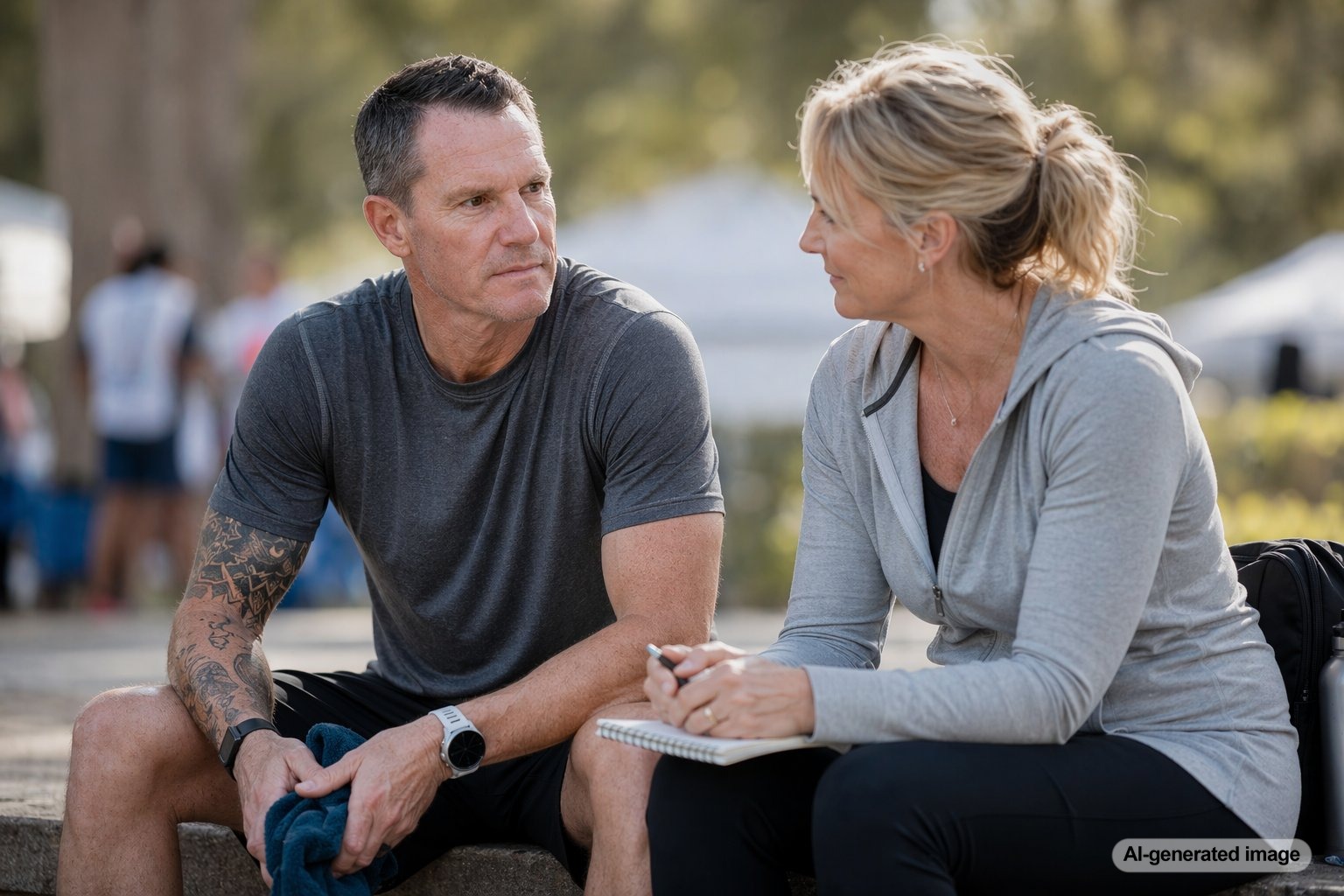
To compete with courage instead of control is to accept a hard truth that every athlete, leader, parent, entrepreneur, and human being eventually meets: you can prepare with discipline, but you cannot command every outcome. The weather can change. The body can surprise you. The business can shift. A diagnosis can redraw the map. The race can ask something from you that the training plan never mentioned.
Courage does not mean pretending those realities are easy. It means stepping forward anyway, with enough humility to respect the unknown and enough conviction to keep moving. For Greg Schaefer, that idea lives at the intersection of endurance racing, family, business leadership, Parkinson’s advocacy, and the simple but powerful belief behind One More Step… Just One More.
Quick answer: what does it mean to compete with courage?
- It means focusing on effort, presence, and purpose instead of obsessing over perfect control.
- It means preparing seriously while staying flexible when conditions change.
- It means measuring strength by how honestly you show up, not only by the result.
- It means carrying fear, uncertainty, or discomfort without letting them make every decision.
- It means remembering that competition can reveal character, not just performance.
Control wants certainty. Courage works with reality.
Control says the day has to go exactly as planned before you can feel confident. Courage says confidence can come from knowing how you will respond when the plan breaks. That distinction matters in endurance sports because no race is completely predictable. It also matters in leadership, health, family life, and mission-driven work because the biggest moments rarely arrive with clean instructions.
Control often sounds responsible at first. It wants the checklist complete, the variables managed, the risk reduced. Preparation matters. Discipline matters. Details matter. But when control becomes the only way to feel safe, it can turn brittle. One unexpected setback can feel like failure before the real work has even begun.
Courage is different. Courage still trains. Courage still plans. Courage still respects the stakes. But courage leaves room for adaptation. It knows that the question is not only, “Can I make this go perfectly?” The deeper question is, “Who will I be when it does not?”
Competing with courage is not the same as being fearless.
Fearless competition is mostly a myth. People who do hard things often feel fear, pressure, doubt, grief, frustration, and vulnerability. Courage does not erase those emotions. It gives them a place to sit without handing them the steering wheel.
An endurance athlete may stand at the start line knowing the day could bring pain, fatigue, or disappointment. A speaker may walk onto a stage knowing the message is personal and the room is full of people with different expectations. A founder may make a decision without perfect information. A person living with a life-changing diagnosis may choose to keep building a meaningful life without knowing exactly what the future will require.
In each case, courage is not a mood. It is a practice. It is the decision to move with honesty, not denial. It is the choice to keep purpose in the room when uncertainty gets loud.
The shift from outcome control to response ownership
One of the most useful ways to understand courage in competition is this: you may not control the outcome, but you can own your response. That does not mean outcomes do not matter. Goals matter. Results matter. Finish lines matter. Standards matter. But when a person ties their entire identity to an outcome, the pressure can become crushing.
Response ownership gives the competitor something steadier to hold. It asks: Did I prepare with integrity? Did I stay present when the day became difficult? Did I adjust instead of unraveling? Did I treat people well under stress? Did I keep taking the next right step?
That mindset is especially powerful because it travels beyond the course. It belongs in boardrooms, family conversations, medical waiting rooms, fundraising work, and community leadership. It helps people understand that resilience is not just about pushing harder. Sometimes it is about choosing the most honest next step when the old definition of control no longer fits.
What people often miss about courage
People often picture courage as dramatic. A huge comeback. A finish-line moment. A speech that brings the room to its feet. Those moments can be real, but most courage is quieter than that.
Courage may look like starting again after a difficult year. It may look like asking for support instead of pretending everything is fine. It may look like adjusting a goal without abandoning the mission. It may look like telling the truth about uncertainty while still choosing hope. It may look like doing the small daily work that no one applauds.
For Greg, that kind of courage is central to the broader message he brings through speaking, advocacy, endurance, and the Forward Motion Fund. It is not about selling an easy version of resilience. It is about showing what forward motion can look like when life becomes more complicated than the original plan.
Practical ways to compete with more courage
Prepare without worshiping the plan. A strong plan gives you direction, but a rigid plan can make every surprise feel like a threat. Build the discipline, then practice flexibility.
Name what is actually in your control. Your effort, your attitude, your pacing, your recovery, your communication, your values, and your next decision are usually more useful focus points than the things you cannot command.
Let purpose be bigger than performance. Performance can rise and fall. Purpose gives the work a deeper center. It reminds you why the effort matters, especially when the result is uncertain.
Practice honest self-talk. Courage is not helped by fake confidence. It grows through grounded language: “This is hard, and I can take the next step.” That sentence is often stronger than pretending the hard thing is not hard.
Stay connected to others. Control often isolates. Courage can invite support. Family, teammates, coaches, colleagues, clinicians, friends, and mission-aligned communities can help carry what no one should have to carry alone.
Competition can become a form of witness
At its best, competition is not only about proving something. It can also become a form of witness. It can show other people what commitment looks like under pressure. It can remind a team that adversity does not have to end contribution. It can help a family see that strength and vulnerability can exist together. It can give a community a living example of persistence without pretending life is simple.
That is why courage has a different weight than control. Control is often private and protective. Courage is often relational. It reaches beyond the individual and gives other people something to believe in, not because the path is easy, but because the effort is real.
FAQ
Does competing with courage mean letting go of goals?
No. It means pursuing goals with discipline while refusing to let a single outcome define your worth, identity, or future. Courage keeps goals meaningful without making them the only measure of success.
How is courage different from mental toughness?
Mental toughness often focuses on staying strong under pressure. Courage includes that, but it also includes honesty, humility, vulnerability, and the willingness to act when certainty is not available.
Can courage be practiced?
Yes. Courage grows through repeated choices: showing up, adapting, asking for support, telling the truth, and taking the next step even when the full path is unclear.
Why does this message matter outside of sports?
Because most people are competing with something, even if there is no finish line. They may be leading a team, supporting a loved one, rebuilding after a setback, or trying to live with purpose through uncertainty.
Interested in bringing Greg’s message to your event or organization?
Learn more about Greg’s speaking work or get in touch to start the conversation.
Contact Greg or learn more about the Forward Motion Fund.
This article is for educational purposes only and is not medical advice. For diagnosis, treatment, or personalized medical guidance, please speak with a qualified healthcare professional.


